
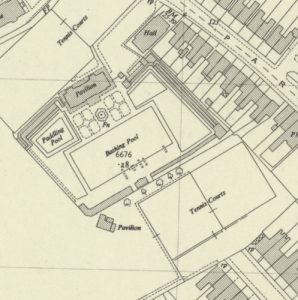

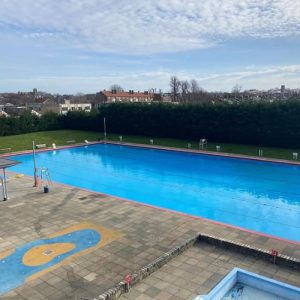
Opened on 1st June 1929, Hornsey Open Air Swimming Pool was one of a number of pools in the borough, all of which have disappeared but Hornsey, now called Park Road Pools and Fitness remains.
The idea for a new pool was not universally supported by local people as many would have preferred a wash house as many local properties did not have bathrooms but the plan for the pool was approved and funding obtained.
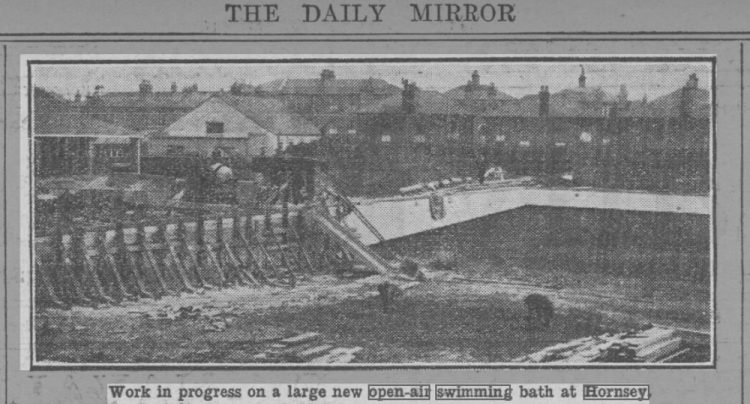
A pool measuring 165’ x 75’ with a maximum depth of 7’ 6” was built and it contained 400,000 gallons of filtered unheated water. The pool cost £12,670 to build. It had a stepped diving platform with a maximum height of 3 metres and at least one 1metre springboard. There were changing cubicles around the perimeter and a pavilion with café.
In October 1929, when the pool had been open for 4 months, 400 steel lockers were installed to prevent bathers clothes being stolen. Prior to that, a basket system operated.
The pool was closed from 1939 to 1946, WWII.
In April 1050, plans were made for a new chlorination plant to be built at a cost of £600.
June 1958 saw the introduction of floodlit dips during a heatwave where the pool remained open for a n extra two hours. In 1958, the pool was the venue for a mass baptism of nearly 600 people.
The diving boards were removed in the 1960’s, a casualty of new health and safety requirements. The pavilion and changing rooms demolished in 1971 to make way for an indoor leisure centre.
The pool was closed in 1989 for three years, but a local campaign saved it. There was a proposal to cover the pool at a cost of £250,000 but this did not proceed.
The pool water was heated from around 1992 when water from the indoor pool was allowed to leak into the lido. It’s not clear how long this lasted as a ‘mistake’ but proper heating for the pool was installed in 1999. From 2014, the pool was heated year-round.
In 2012, Fusion Lifestyle took over the management of the facility and promptly demolished the only remaining original feature, the aerator fountain. Well done, Fusion. On the upside, outdoor showers and a changing block were built in a refurbishment that temporarily closed the pool until 2014.
The pool closed again in December 2017 when a leak was discovered, and this took until May 2018 to repair.
The Park Road Lido User Group was established at this time and they campaign for longer opening hours and improved facilities.
In October 2024 Haringey Council took the lido back under its control and not a moment too soon by the sound of things.
| Name | Hornsey Open Air Swimming Pool aka Park Road Lido Playing Fields, Park Road, Hornsey, LB Haringey, N8 8JN, England |
| Coordinates | 51°34’58.2″N 0°07’47.6″W |
| Opened | 1st June 1929 by Mayor, Alderman Mr G A Double |
| Cost | £12,670 |
| Dimensions | 165′ x 75′ |
| Capacity (UK gallons) | 400,000 |
| Water type | Fresh water |
| Depth(s) | Max 7′ 6″ at centre |
| Diving | Stepped to 3m fixed platform, 1m springboards, removed in the 1960’s |
| Changing facilities | 175 cubicles opening out onto grass sunbathng area. Basket storage for clothing. |
| Second pool | Paddling pool |
| Spectator seating | Grassed sunbathing area and covered verandah |
| Designers and contractors | W H Adams, Borough Engineer Arundel Ltd – contractor |
| Date closed | N/A |
| Status | Open |
| On site now | The pool |
| Links | Water Witches – Hornsey Open Air Swimming Pool (1929) – Hornsey Historical Society |
| Last updated | 1st June 2026 |


Baths and Bath Engineering, July 1936
Dressing Accommodation for Swimming – MILNERS’ STEEL LOCKERS
In the design and working of modern covered or open-air swimming baths, one of the main points for consideration is the dressing accommodation for bathers.
Every bather should have sufficient room for undressing, adequate accommodation for clothing, and above all, security from theft.
Several new systems of dressing accommodation are in use, having been introduced in the past few years.
Relating to the locker system of dressing accommodation, the steel clothes lockers manufactured by Messrs. Milners’ Safe Co., Ltd., of London, afford, it is stated, an inexpensive and efficient method of increasing the accommodation of existing baths without adding to the number of dressing rooms, and an installation of clothes lockers will also enlarge the capacity of new baths with the maximum of economy in cost and space. These lockers can be supplied either 66 in. high with solid base, or 72 in. high with 6 in. sanitary legs, and are usually provided with spring locks instead of the dead bolt type, also trouser rails or other special fittings as required.
The lockers can also be fitted with a self-opening device which permits the doors to remain open at right angles when unlocked, thus enabling the attendant to see which lockers are unoccupied.
Extension lockers can be added to a group to suit requirement, as shown in fig. 2. This is one section of an installation of back-to-back clothes lockers at Hornsey open-air swimming bath, which is shown in fig. 1.
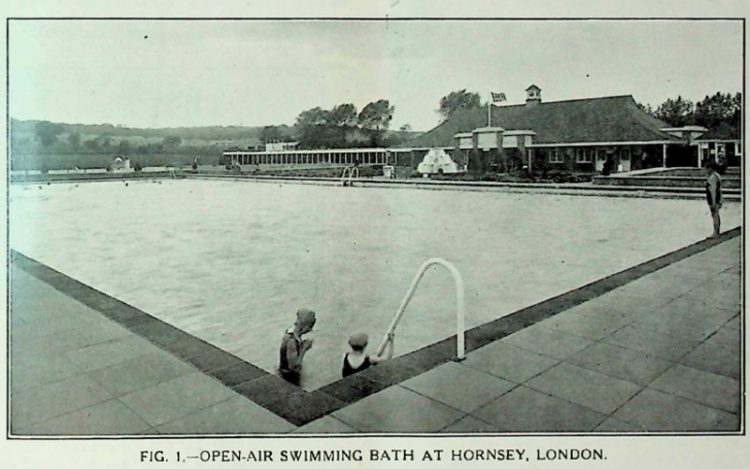
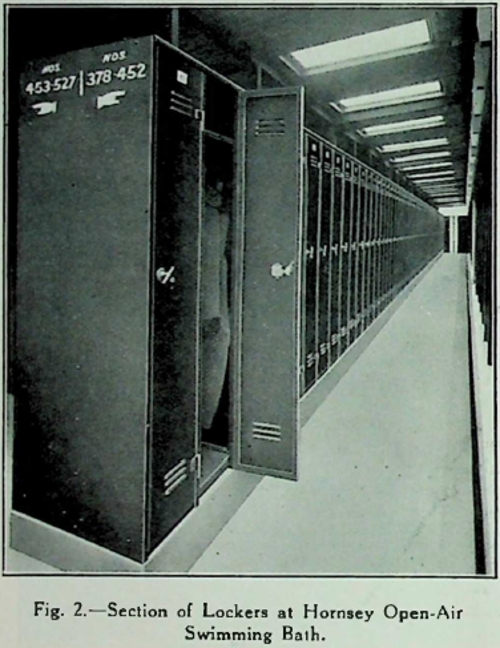
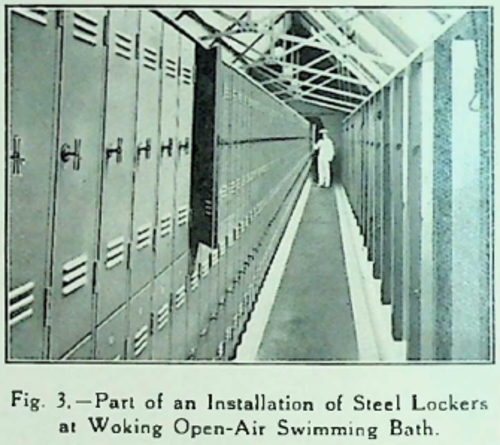
Fig. 3 illustrates part of an installation of steel clothes lockers at Woking open-air swimming bath.
The number of lockers to be installed should be determined by the size of the bath and the previously determined bathing load in the case of a new bath, or an average peak load with a margin of 20 per cent. in a reconstructed bath.
A suitable ratio is three lockers to one cubicle for covered baths, and from six to ten in the case of open-air baths. The locker-room should be so arranged to enable the speedy dispersal of bathers to prevent congestion, and to facilitate efficient working by a minimum of staff. The lockers could be built around the sides of the room, with cubicles of a fixed or portable nature in the centre, or the cubicles built around the side and the lockers in the centre.
The accommodation at open-air swimming baths can be increased considerably by installing clothes lockers in conjunction with cubicles.
The system of checking with lockers is a very simple one and the bather soon becomes accustomed to it. On tendering the money at the cash office, the bather is given a ticket and a numbered wrist band, or other means of identification. The bather then visits the locker-room and engages the locker with the number corresponding to that on the wristband or disc. Undressing in a near cubicle, the bather places his or her clothing in the locker, and after locking it proceeds to the bath via the footbath. On returning to the locker-room the bather hands the wristband or disc to the attendant, who unlocks the locker with his key.
The chief advantages of the locker system are: -Security from theft; sanitation; privacy.
Messrs. Milners’ steel compartment lockers have been supplied to a great many corporations, councils, and private baths, such as Barking, 1,200; Enfield, 1,283; Luton, 1,100; Scarborough, 1,600; and Woking, 1,040.
Messrs. Milners will be glad to submit lay-out drawings and estimates for complete locker installations, on receipt of full particulars.
