
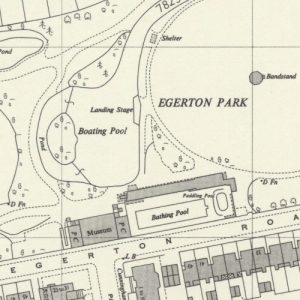
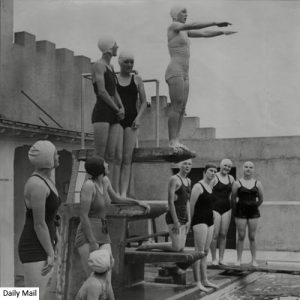
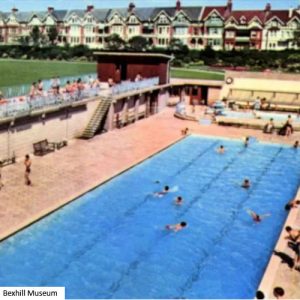
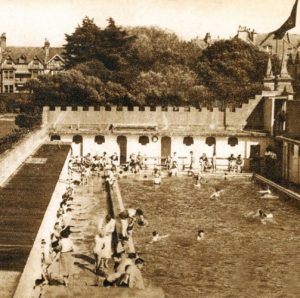
One of the first enterprises in the early development of Bexhill as a resort was the construction of the Egerton Park Swimming Bath. The site was part of the Egerton Park Estate and remain in private hands until 1901 when it was adopted by the local authority.
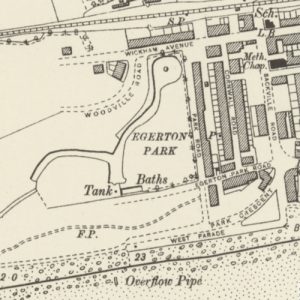
The initial work was very basic. Reports show that it was carried out by the owner, Mr John W Webb and consisted of lining an existing depression with concrete walls and filling it with sea water through an iron pipe from the western shore.
1908 saw improvements that included the addition of 10 dressing cubicles, the floor resurfaced, the walls covered with white glazed bricks, and the repainting of all cubicles.
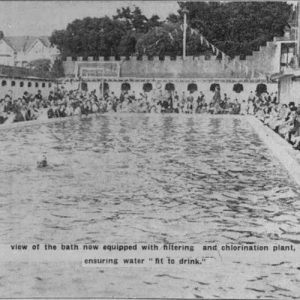
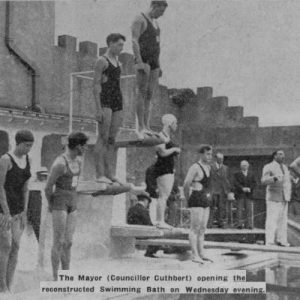
The pool deteriorated over time and a major rebuilding was undertaken in 1936 and the pool was re-opened in 1937. The mayor, in his opening speech referred to the old baths as a “positive disgrace.” The water was somewhat murky during the opening ceremony as insufficient time had been allowed for sand pumped in with the sea water to settle but the mayor gave his assurances that the pool was “free of germs of all descriptions.”
By 1957, around 25,000 people were using the baths and there were calls for improved facilities including better refreshments, a safer entrance and more changing cubicles. Councillor Mrs E J Myers cited the fact that the Bexhill Swimming Club were unable to compete on equal terms with other clubs due to the poor facilities. There were arguments that a potential spend of £5,000 would be better put towards an indoor pool. In 1958, there was one of a number of schemes to cover the pool, this one proposed by the Bexhill Amateur Swimming Club but this was refused.
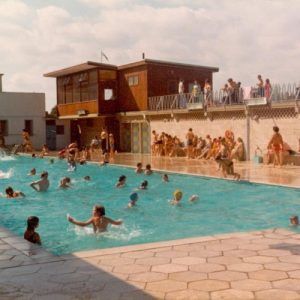
A staged plan of improvements commenced in 1960 with a total expected expenditure of £27,443. The first two stages included the extension of the enclosure, an office, entrance hall, clothes storage, changing cubicles, sanitary arrangements and drainage, kitchen, a new footpath in the extension, drainage to a new future paddling pool, a new high-pressure water main with provision for future connection to a cascade and paddling pool, and the making up of levels of the paved surround to finish level with the existing parapet of the pool.
£17,000 was to be spent on stage 1 and the contract was awarded to Williams Brothers (Carshalton) Ltd but early into the scheme, work was halted and the council had to take back the project.
Stage 2 of the works costing £8,415 was approved in July 1962 and an additional £500 was spent on laying out terraces, seating and an ornamental garden. The works included provision of 54 cubicles and the addition of the use of clothes hangers, stored in the ticket office to increase the capacity.
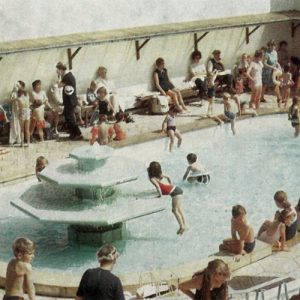
Stage 3 of the works included an extension of the bath area eastwards to provide a paddling pool, first aid room, cascade, paved area and seating, new access to the park and a cycle store, at a total estimated cost of £6,000. The works were carried out during the winter of 1963-64.
In 1972, aware that the closure of the pool at the end of each September caused the local swimmers to travel to either Eastbourne of Hasting for their swim, Borough Surveyor, Mr A. G. Whiteside, was tasked with producing a scheme for roofing the baths. Four preliminary schemes have been considered by the Borough Amenities Committee, but it favours one which would provide a mono-pitched roof on a concrete frame with sliding roof-light panels extending over the Observation Gallery. All the schemes were expected to cost between £40,000 and £50,000. At present the Baths close at the end of September, when local swimmers have to travel either to Eastbourne or Hastings.
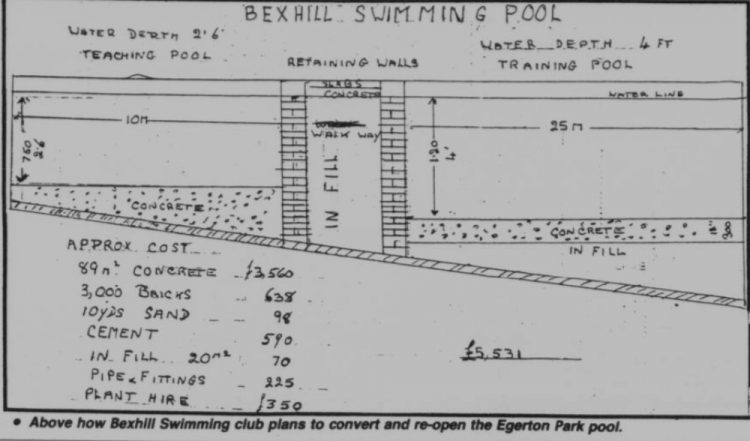
In January 1985, the swimming club were given permission to take over the pool as long as they were able to meet the running costs of around £13,000 per year. They proposed splitting the pool into two sections thus providing a level floored teaching pool. See below for sketch.
Whilst able to meet the financial obligations, the council imposed strict conditions that the club take out public liability insurance through their own insurers and as the non-financial conditions could not be met, the scheme was abandoned and the pool closed.
The council gave the public until October 1986 to object to the demolition of the pool. It was finally demolished in 1987.
| Name | Egerton Park Swimming Bath |
| Built | Originally 1889 then 1937 |
| Opened | 28th July 1937 by the Mayor, Councillor Cuthbert |
| Cost | 1937 reconstruction – £1,730 1964 – Stage 3 refurbishment – £7,469 |
| Dimensions | 120′ x 39′ |
| Capacity | |
| Depth | 3′ to approx 6′ |
| Diving | Cocnrete diving stage and springboard addin in 1937 |
| Second pool | Small childrens paddling pool with aereator adding in 1960s |
| Designer | |
| Address | Egerton Park, Egerton Road, Bexhill on Sea, West Sussex, TN39 3HL |
| Date closed | 1985 |
| Status | Demolished 1987. Site is now the Bexhill Museum. |
| Last updated | 10th March 2026 |
Bexhill On Sea Observer 31st July 1937
A BIG SPLASH
Reopening of the Swimming Bath
WATER “PURE ENOUGH TO DRINK”
A big splash marked the reopening of the Corporation Swimming Bath on Wednesday evening. The ceremony was performed by the Mayor (Councillor W. N. Cuthbert, J.P. and as he spoke the words again brought the bath into use clever swimmers plunged into the water A large crowd of spectators gathered for the occasion, and associated with the ceremony was a series of competitive events between local and Hastings swimmers arranged by the Bexhill Swimming Club. Measuring 120 ft. by 39 ft, the baths has been completely reconstructed and equipped with the latest type of plant which purities the water every four hours by a three-fold process of filtration, aeration, and chlorination. A new diving stage in reinforced concrete and a springboard have also been included. The cost of the complete scheme was £1,730, of which £975 was for filtration plant and builders’ work. The depth of the water has been increased by the formation of a coping, a foot high and along both sides scum channelling has been fitted. The contract for the installation of the purification plant was carried out under the direction of the Borough Surveyor (Mr. W. Pearce, and the Water Engineer (Mr E. Pollard) had charge of the reconstruction work which was also done by contract Members of the Council present in addition to the Mayor, were Alderman R. C. Sewell, Alderman A. H. Davis, J.P., Councillor W, T. M. Wright (chairman of the Pleasure Grounds Committee, which controls the bath), Councillor H. L. Neale and Councillor E. J. Bowles. The officials included the Town Clerk (Mr. S. J. Taylor), the Borough Surveyor, and the Water Engineer.
THE MAYOR’S ADMISSION
Pointing out that the water might appear a little dark, the Mayor said that perhaps they should not have opened the bath for another three or four days, which would have allowed small particles of sand pumped in with the sea water to settle, but he could assure the public that with the plant which had been installed the bath was free from germs of all descriptions. The water was pure enough to drink, and the colour would disappear in a few days time. He admitted, even as one of the Council, that the bath was a positive disgrace before. but now it was as good as they would get anywhere. The Mayor formally declared the bath open and dived in with the swimmers.
As president of the swimming Club, Alderman Sewell then asked the Mayor to present a number of awards won in life saving competitions by members of the club during the past few months. “I am glad to be able to tell you,” added the President, “that the Bexhill Swimming Club is proud of its life saving work, and at the present moment it is the champion club of Sussex, both in the ladies’ and men’s divisions, in lifesaving competitions.” (Applause.) That said a great deal for the valuable work in instruction of Mr. James Stewart – a Scotsman, the Mayor would be pleased to know—who lived in Bexhill for some years, and who was particularly interested in developing life saving work. Unfortunately, Mr. Stewart had now left the town, having taken an appointment abroad. The Mayor presented the awards as follows:-
Intermediate certificates (carrying with them bronze medallions), Miss B Orsman, Miss J Mepham, Miss B Nash, Messrs. D R Adams, W Adams, A Cane, G Cane, H K Mepham, J L Mullet, and W E Norwell.
Awards of merit (with silver medallions), Messrs. W E Norwell, A Cane, and G Cane.
First class instructors certificate – Mr W E Norwell.
A FINE EXAMPLE
Congratulation the winners, the Mayor said they had set a very fine example to the youth of Bexhill. He pointed out how useful this proficiency in life saving, especially in a seaside resort and hoped their example would be followed by many more Bexhillians, both ladies and gentlemen.
Prior to the races, a demonstration of fancy stokes used in life-saving examinations was given by Messrs A Cane, G Cane, and F Hughes and for the finale, an exhibition of “porpoise” swimming, they were joined by Messrs J White and W E Norwell.
Of the ten competitive events, seven were won by Hastings and three by Bexhill. Hastings were also the winners of a water polo match by four goals to one.
Alderman Sewell was M.C. for the races, and the other officials were Messrs A Merritt and M J Mitchel (judges), H Vieler (starter), W C Greed (timekeeper), Miss Waller, and Mr H Burgess, (stewards).
Mr Gordon M Mitchell, as the hon. Secretary of the Bexhill Swimming Club spent a very busy time and his services were specially acknowledged by Alderman Sewell, who also thanked Councillor Wright for this attendance and spoke of the excellent work of Mr Pearce and Mr Pollard in connection with the reconstruction of the bath, Season tickers for the bath, it was announced, were being issued at 5s.
